Codex 또는 Claude가 MCP 컨텍스트를 읽고 LaiCai Flow 초안을 만든 뒤 안전하게 검토, 검증, 실행하는 방법. LaiCai Screen Mirroring.
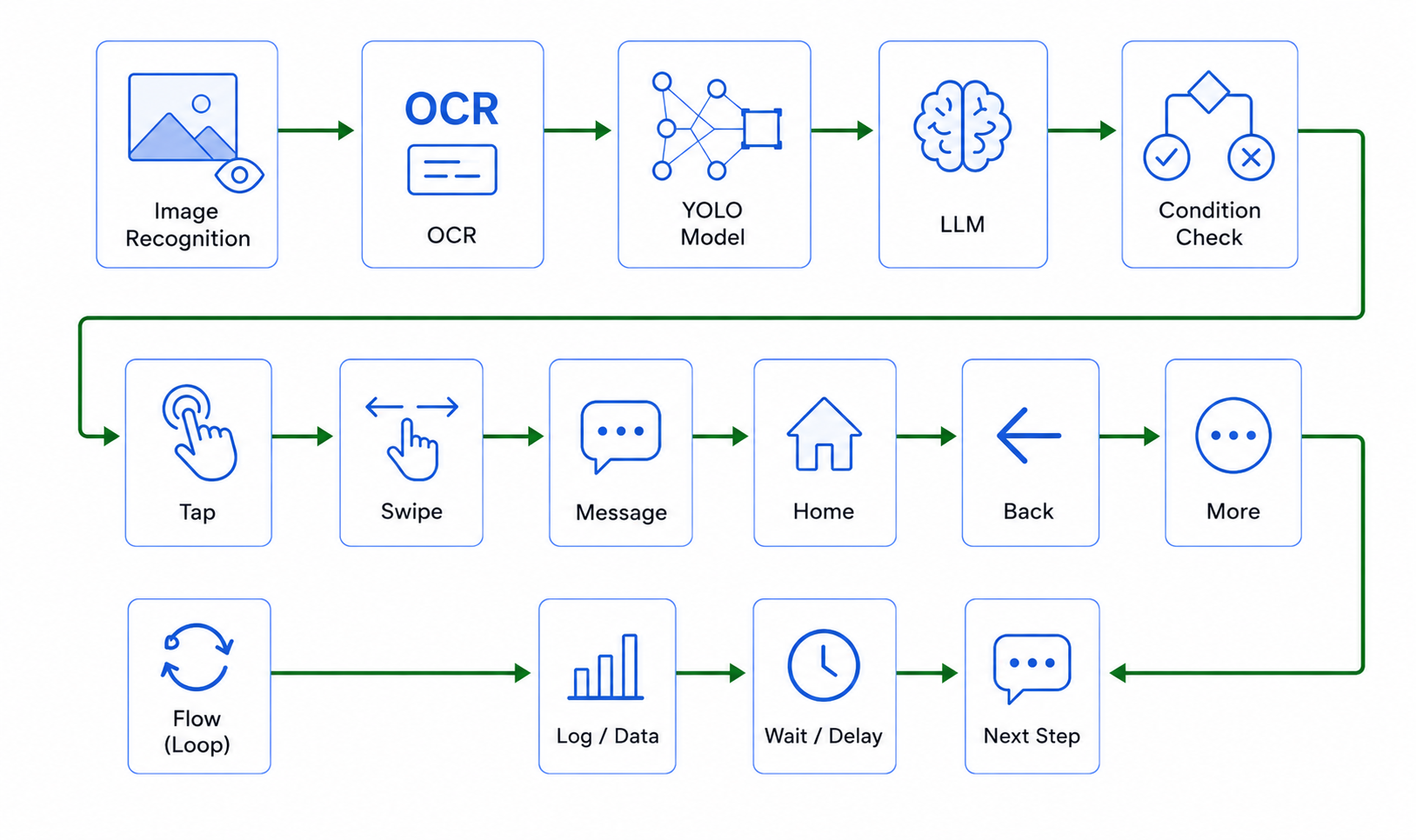
Codex 또는 Claude가 MCP 컨텍스트를 읽고 LaiCai Flow 초안을 만든 뒤 안전하게 검토, 검증, 실행하는 방법.
MCP가 초안 생성을 바꾸는 이유
MCP gives AI tools structured context instead of asking them to rely on memory. For Android automation, that means the assistant should read generation rules, node schema, assets, and device context before drafting a Flow.
LaiCai Screen Mirroring keeps the run visible: Codex or Claude helps draft, while LaiCai Flow executes and records the authorized workflow.
LaiCai MCP가 제공해야 할 컨텍스트
LaiCai MCP context should include naming rules, profile defaults, stop-on-failure behavior, asset boundaries, device list, and the node schema. If package names or visual targets are unknown, the assistant should not guess.
In this session the live LaiCai MCP tools were not exposed, so the article uses local MobileFarm product docs and verified Flow publishing context as the source of truth.
안전한 초안 흐름
A safe request names the target app, account type, environment, evidence, and stop boundary. A good draft may open a staging app, use a test account, capture a screenshot, use OCR, and stop before a risky step.
The first run should be observed through Android 화면을 PC와 Mac으로 미러링.
MCP tool의 경계
MCP tools can read schema, profiles, assets, devices, installed packages, UI trees, screenshots, and recent run state. Save and asset-creation tools need more caution because they change the user's automation library or create fixed visual assumptions.
The model should not guess coordinates, templates, OCR regions, model classes, package ids, or destructive actions.
팀에서 LaiCai Flow의 역할
The accurate relationship is: Codex or Claude can generate or revise the draft, and LaiCai Flow runs, debugs, logs, and reviews it on authorized Android devices and emulators.
Use AI Android 자동화 도구, LaiCai Flow 가이드, and LLM 생성 Android 워크플로 as the core reading path.
저장 전 체크리스트
Before saving, verify node types, package source, visual evidence, screenshots or logs, readable Graph View names, and explicit stop boundaries for payment, deletion, account settings, private data, or outbound messages.
The useful pattern is context-aware drafting plus visible execution, not a hidden prompt that controls everything.