People who search for a LaiXi alternative, a QtScrcpy alternative, or a broader scrcpy alternative are usually not asking which tool is “bad.” They are asking a workflow question: which Android control tool fits the way they actually work every day?
LaiXi, QtScrcpy, scrcpy-style tools, and LaiCai Screen Mirroring all sit near the same Android screen mirroring and Android control problem, but they are designed for different users. Some users need lightweight technical mirroring. Some need a multi-phone workspace. Some need game key mapping. Some need a tool that works on Mac as well as Windows. The right answer depends on the job.
This comparison is intentionally neutral. LaiXi has value for users who want a business-oriented mobile control platform. QtScrcpy and scrcpy are valuable for technical users who like open-source Android mirroring and direct device control. LaiCai Screen Mirroring is positioned for users who want real Android phones on a PC or Mac with a visual workspace, keyboard and mouse control, game key mapping, screenshots, recording, file transfer, and multi-device operation.
Quick Comparison
| Workflow need | LaiXi | QtScrcpy / scrcpy-style tools | LaiCai Screen Mirroring |
|---|---|---|---|
| Business or marketing device management | Often considered by users who need phone management workflows | Possible, but more technical and less business-oriented | Useful for visible real-phone workspaces, device groups, support, e-commerce, QA, and creator workflows |
| Open-source technical mirroring | Not the main positioning | Strong fit, especially for technical users comfortable with setup details | Product UI rather than open-source tooling |
| Mac support | Check the current product plan before choosing | scrcpy-style tooling can run cross-platform when configured correctly | Designed to support Windows and macOS workflows |
| Mobile game keyboard mapping | Depends on the product workflow | Possible with technical setup or extra tools | Built around visual key mapping, mouse look, WASD, custom controls, and game profiles |
| Team onboarding | Depends on team use case | Best for technical operators | Better when non-technical users need a visible daily workspace |
What LaiXi Appears to Fit Best
LaiXi is a relevant product to look at when the user is thinking about Android phone management, mobile operations, and business workflows. For teams that mainly evaluate products around device management, account workflow, or operational control, LaiXi may be part of the shortlist.
The practical question is not whether LaiXi exists in the same market. It does. The practical question is whether the user needs the exact LaiXi-style workflow, or whether they need a cross-platform real-phone screen mirroring workspace with game controls and multi-device visibility. If the user is a marketer, e-commerce operator, livestream team, or phone-farm operator, they should compare the number of devices, operating system support, keyboard/mouse comfort, recording needs, and how easy it is for staff to use the tool every day.
What QtScrcpy and scrcpy-Style Tools Fit Best
QtScrcpy is known as a graphical client around the scrcpy ecosystem. The broader scrcpy family is respected because it is lightweight, technical, fast, and useful for Android display and control through USB or network workflows. For developers, Linux users, and technical operators, this type of tool can be very efficient.
The trade-off is that technical power does not always equal the easiest daily workflow. A creator who wants to record mobile gameplay, an e-commerce team that needs screenshots from several phones, or a support team that needs a repeatable workspace may not want to assemble a toolchain around command-line options, separate key mapping behavior, and multi-device window organization. For those users, a product workspace can be faster to teach and easier to repeat.
Where LaiCai Screen Mirroring Fits
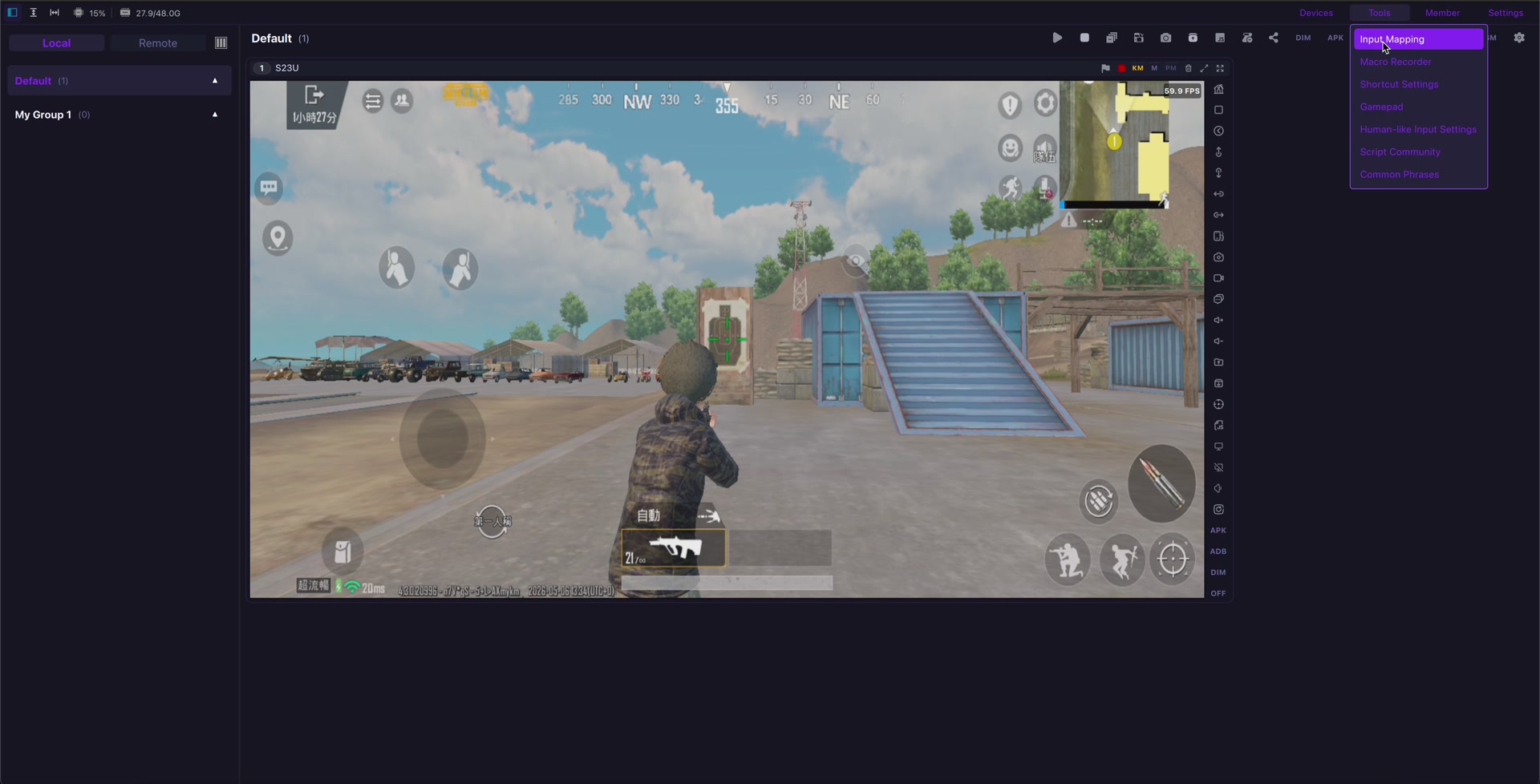
LaiCai Screen Mirroring for Android screen mirroring on PC and Mac is built around real Android phones. That matters because many users do not want an emulator or cloud phone to replace the device. They want the actual phone screen, the actual app environment, the actual game account, and the actual device behavior visible on the computer.
LaiCai focuses on four workflows:
- PC/Mac Android control: mirror and control real Android phones from a desktop workspace.
- Game control: use custom Android game key mapping, mouse look, WASD movement, fire buttons, skill keys, camera controls, and game-specific profiles.
- Multi-device operation: use multi-device Android control for support, e-commerce, QA, creator work, device labs, or legitimate phone farm software workflows.
- Daily productivity: screenshots, screen recording, file transfer, APK install, and device organization in one visual workspace.
For Gamers: The Key Difference Is Control Mapping
If your main search intent is “how do I play Android games on PC,” the comparison changes. Lightweight mirroring alone is not enough. You need practical control. For PUBG Mobile, Free Fire, Call of Duty Mobile, Blood Strike, Arena Breakout, Mobile Legends: Bang Bang, Honor of Kings, Genshin Impact, Roblox, Minecraft, and similar games, the important details are aiming, movement, camera control, skill buttons, inventory, map, reload, crouch, jump, sprint, and quick item use.
That is why LaiCai points game traffic toward playing Android games on PC with a real phone. The user keeps a real Android device, but the computer becomes the larger screen and control surface. Key mapping can be adjusted game by game instead of forcing every game into one generic mirror window.
For Teams: The Key Difference Is Repeatability
Teams do not only need a screen. They need a repeatable process. A support team may need to reproduce a customer issue, record proof, and hand the case to the next shift. An e-commerce team may need several phones for shop apps, chat apps, product checks, and order messages. A QA team may need real-device screenshots and recordings. A creator team may need consistent tutorial recording.
In those cases, the tool should reduce confusion. Device names, device groups, visible screens, quick screenshots, recording, and stable USB/Wi-Fi workflows matter more than a single “mirror window.” This is where LaiCai is different from a purely technical mirror tool.
Which Tool Should You Choose?
Choose LaiXi if its product workflow and pricing fit your business operations and your team is mainly evaluating mobile device management around that model. Choose QtScrcpy or scrcpy-style tools if you prefer open-source tooling, technical control, and a lightweight setup you can customize yourself. Choose LaiCai Screen Mirroring if you want a visual PC/Mac workspace for real Android phones, game key mapping, multi-device control, screenshots, recording, and easier onboarding for non-technical users.
The best choice is not the tool with the longest feature list. It is the tool that removes the most friction from the work you do every day.
FAQ
Is LaiCai Screen Mirroring a scrcpy replacement?
For some users, yes. For technical users who only want lightweight open-source mirroring, scrcpy may still be the better fit. For gamers, support teams, e-commerce teams, QA teams, and multi-device users who need a visual workspace, LaiCai is often a more complete workflow.
Is LaiCai only for games?
No. Games are one important use case because keyboard mapping matters, but LaiCai also fits support, e-commerce, app testing, training, creator recording, and multi-phone operations.
Can LaiCai help with phone farm software workflows?
Yes, for legitimate real-device workflows where users need to organize and operate multiple owned Android phones. It should not be used for spam, fake engagement, platform abuse, or rule evasion.
Why compare LaiXi and QtScrcpy together?
They represent two different directions people consider: business-oriented device operation and technical open-source-style Android control. LaiCai sits between those needs by offering a product workspace for real Android phones, PC/Mac control, key mapping, and multi-device visibility.