I build software with AI,and it's not just faster, it's different
I have 10 years of full-stack solo development behind me, and I'm 100% self-taught. Over the past year I've moved completely from traditional software development to AI-Native Development. I no longer measure my work by how much code I write by hand. Instead I focus on system architecture, Agent and Skill design, task breakdown, Context Engineering, development standards, and verification, so that AI can keep delivering complex software engineering work.
100% AI-written code, a commercial product run by one person
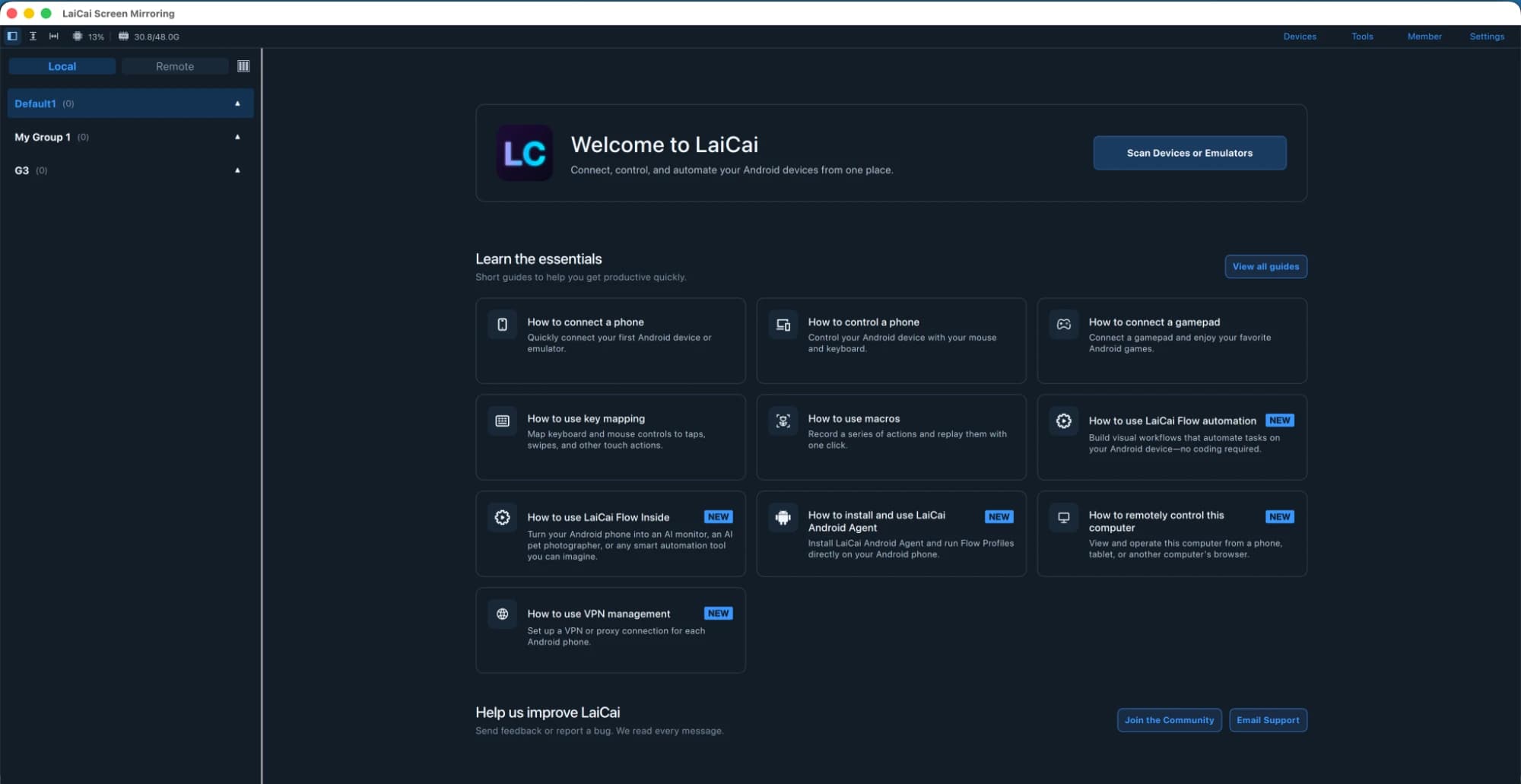
I use this approach to build and run my own product: LaiCai Screen Mirroring (LaiCai), a cross-platform Windows / macOS platform for mirroring, controlling, and automating Android phones with AI. It includes multi-device mirroring and control, keyboard, mouse, and gamepad mapping, Macro, LaiCai Flow visual automation, AI Planner, MCP, Android Agent, screen recognition, remote PC control, plus account licensing, payments, the backend, an admin console, the website, and an SEO content system.
The long feature list isn't the most unusual thing about it. What is unusual is this: the frontend, backend, desktop client, admin console, website, payments and membership, and automation system are all 100% implemented by AI, and I don't write any of the code myself. I decide what to build, why to build it, how the system is designed, how tasks are split, how the Agents work, which rules the AI must follow, and whether the result is correct.
Code is only one part of it. Documentation, testing, deployment, SEO, marketing, image and video production, and day-to-day operations all involve AI deeply too, and roughly 95%+ of the actual execution work across the whole company is done by AI.
Before this: 10 years of full-stack solo development, 100% self-taught
I used to be a businessman. I ran businesses for more than ten years before switching to software. I never studied programming with any teacher; everything I know came from Google searches and open university courses, and for nearly ten years I learned English and computer science side by side. Since then I've built apps, backends, websites, and desktop software on my own, owning everything from architecture to launch.
Selected projects:
- LaiCai Screen Mirroring — A platform for mirroring, controlling, and automating Android phones with AI, and the project with the widest technical range I've worked on.
- Ashera Pet — A social-style app that I developed entirely on my own, now live on the App Store and Google Play.
- VocaSeek — An AI language-learning tool that supports 21 languages.
- Chain-store POS system — Multi-store, membership, inventory, and payroll, running on iPhone, iPad, and macOS.
- Vocabulary / Thai-learning apps — Two independently published iOS apps that bring in a steady small income every month.
My role has changed, but I haven't left software engineering
I've gone from Developer to Architect / AI Agent Designer / Product Builder. I used to ask, "How do I implement this feature?" Now I ask: how do I design a system so that AI can implement it correctly?
AI already knows how to write code. The hard part is getting it to deliver an ever more complex product consistently, reliably, and under control. That is what I mainly research and practice now:
System architecture
Deciding how the system is split, how modules communicate, what goes to the client, what goes to the server, and what goes to an Agent. AI handles the implementation, but the architecture determines what the AI ends up building.
Agent design
It isn't enough to toss requirements at an AI. I design separate roles and contexts for planning, coding, review, debugging, and research, turning AI from a chat assistant into a software engineering system.
Skill design
I distill architecture, coding standards, UI standards, debugging methods, release processes, and SEO methods into Skills. The AI doesn't have to re-learn the whole project every time, because it already carries the project knowledge and repeatable workflows.
This isn't Vibe Coding
I don't have AI generate code at random and keep retrying until something happens to run. What I care about is building an engineering system that AI can maintain over the long term: architecture, context, Agent collaboration, Skills, rules, documentation, task breakdown, code review, testing, debugging, and release processes.
The goal isn't to get AI to write more code, but to get AI to deliver ever larger engineering projects.
It's already a real business
The easiest thing to build with AI Coding is a Demo. The hard part is shipping a product, keeping it running for the long haul, and getting real users to use it and pay for it. LaiCai Screen Mirroring is officially launched, with real users and real paying customers, some of whom have chosen the annual plan, and the product keeps iterating and growing steadily. It isn't a Hackathon entry, and it isn't a showcase built to prove that "AI can write code."
It also tests a question I've been exploring all along: in the age of AI, how big a software company can one person run? The work that used to take developers, frontend and backend engineers, designers, QA, DevOps, documentation, SEO, marketing, video, and customer support, I'm putting back together in a new way: I take care of direction, judgment, architecture, and product, and AI carries the vast majority of the execution.
How I can help
I'm not a great fit for roles that mean "write code to spec." I'm a better fit for these:
- AI-Native software development: Redesigning the development process so AI becomes part of the engineering system, not just a Copilot.
- Agent architecture: Designing Agents for Coding, Research, Review, Debug, Automation, and more, along with how they collaborate.
- Skills and Context Engineering: Turning your team's experience and standards into a body of knowledge that AI can execute reliably.
- Product architecture: Starting from requirements, designing the overall structure of the client, frontend, backend, AI, automation, and infrastructure.
I have a traditional software development background, I'm practicing AI-Native Development in a real commercial product, and I know how to turn it into a product with users and revenue. When AI can handle 100% of the code implementation, where should human engineers spend their time? That's the question I'd love to talk with you about.
If you're looking for someone like this
I'm especially interested in opportunities like these:
If all you're looking for is a Developer in the traditional sense, I may not be the best fit. But if you're thinking about how to bring AI into software engineering for real, how to design Agents and Skills, and how one person can do what used to take a whole team, then we should talk.